01 · OBSERVE
The idea was generated, not discovered
Generated ideas share a signature: they describe a product but cannot name a person currently in pain.
Second Edition · 2026
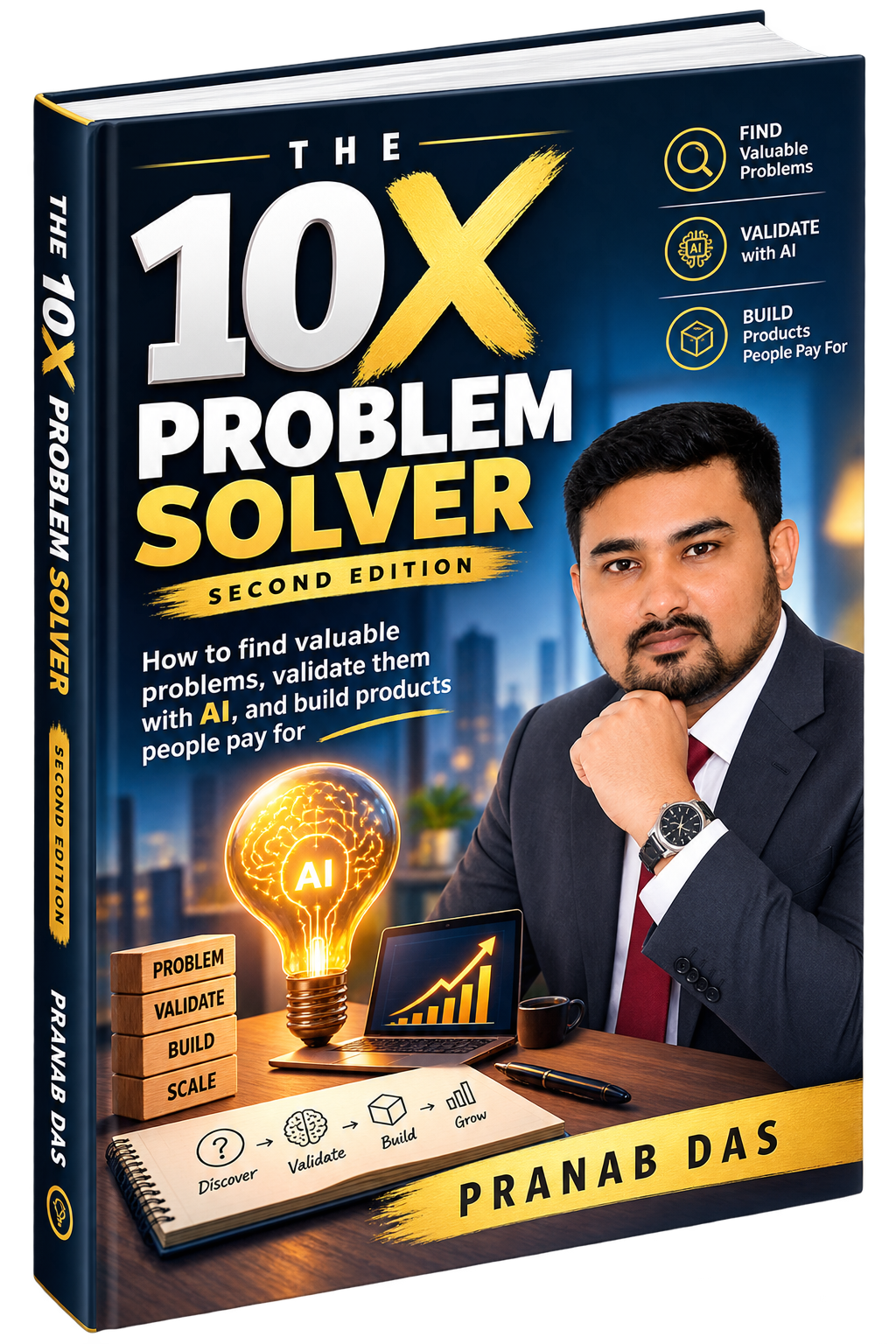
How to find valuable problems, validate them with AI, and build products people pay for.
The difficult part is no longer producing software. The difficult part is finding a problem that is painful enough, recurring enough, reachable enough, and valuable enough to deserve building around.
This is a practical system for finding problems, validating them, narrowing them into something solvable, testing willingness to pay, building the thinnest useful solution, measuring what happens, and deciding whether to continue or stop.
Digital ebook · Second Edition · 2026
The real failure point
Post mortems of small products are boringly consistent. The cause of death is rarely the code. It is one of six failures, and every one of them happens before a line of code is written.
01 · OBSERVE
Generated ideas share a signature: they describe a product but cannot name a person currently in pain.
02 · SCORE
Plenty of things are mildly annoying. Almost none justify a new vendor, a new login, and a recurring charge.
03 · INTERVIEW
The junior analyst suffers, the department head buys. You get enthusiastic demonstrations and no purchase orders.
04 · SCORE
Two million of them means nothing if they gather nowhere. If you cannot name the place, it is a marketing problem in disguise.
05 · SLICE
Nobody migrates data and retrains a team for thirty per cent better. They do it for four minutes instead of four hours.
06 · SCALE OR KILL
Once you have named it and imagined the landing page, contradicting evidence starts to look like a solvable objection.
Every failure above is a research failure, not a technical one. The leverage in a first product is almost entirely in the first thirty days, before anything is built.
The 10X reframe
Solve one painful, recurring problem ten times better for a group narrow enough that you can name its members individually.
Not a platform, not a suite, not a category. One workflow that currently costs someone hours, money, or risk.
Small businesses is a census category. Independent consultants in one city who file fewer than fifty applications a year is a market.
If you cannot state the improvement as a multiple, you do not have a product yet. You have a preference.
10X is a depth instruction, not a size instruction. Go narrow enough to be certain, and improve enough to be worth switching for.
The signature framework
Nine stages from problem discovery to a real product decision. Movement is forward only after evidence, and backward whenever evidence is missing.
Find
01
Collect raw problem evidence in other people's words, without judging any of it.
Exit: fifty logged observations
02
Rank candidates against seven fixed criteria and two hard gates.
Exit: top three survive both gates
03
Test the problem against people who live it. Ask about last month, never about next year.
Exit: six of ten describe the same pain
Decide
04
Turn evidence into a defensible problem statement. You collect, AI organises, you decide.
Exit: problem, cost, failed alternatives
05
Cut the problem to the one step worth solving completely, and write down the non goals.
Exit: a one page PRD exists
Prove
06
Get a paid commitment before building. Offer to solve the slice by hand, this month, for money.
Exit: someone has paid
07
Produce the thinnest thing that delivers the outcome. Descend the build ladder only when demand forces you.
Exit: a real user did the real job
08
Watch activation, return, and repeat payment. Return is the number that predicts survival.
Exit: you know it person by person
09
Decide on criteria you committed to in advance. A fast, honest kill is a completed experiment.
Exit: you honoured your criteria
The framework is a loop, not a line. Killing at stage nine returns you to stage one with a mapped industry, a contact list, and better instincts. That is a good outcome.
Fifteen chapters in four parts
Part one
Where valuable problems hide, and how to test one before committing months.
Part two
Using AI as a thinking instrument, and cutting a large problem down to one buildable thing.
Part three
Getting paid before you build, and reading the only numbers that predict survival.
Part four
The ways this goes wrong, and a workbook that puts the framework into your calendar.
The toolkit
Eight sections of templates and worksheets sit at the back of the book. They are the part you use while the work is happening, not the part you read once.
A
Sixteen prompts organised by the eight AI roles: research, clustering, critique, interview synthesis, slicing, pricing, outreach.
B
One row per observation: source, verbatim quote, frequency, workaround, cost, and where those people gather.
C
Seven dimensions, scoring anchors, two hard gates, and a decision band. One card per candidate problem.
D
Thirteen questions about past behaviour, the commitment ask, and a same day notes template.
E
Problem, user and buyer, the slice, one success metric, five non goals, the riskiest assumption, acceptance criteria.
F
Eight sentences to complete with a number and a date before you begin building, and a named person to hold them.
G
Every term as this book uses it: Solvable Slice, Wrapper Trap, hard gate, activation, return, non goal, Build Ladder.
H
What was retained, what was rewritten, and what was added in this edition, stated plainly.
Digital ebook · Second Edition · 2026
Chapter fourteen · the workbook
One to two hours a day. The workbook places the framework into a calendar: each phase has an objective, a task, a required output, the 10X question to ask yourself, and the trap that catches most people at that point.
The end of the sprint is a decision made on evidence. It is not a launch, and it is not a promise about revenue.
Week one · days 1 to 14
Personal inventory, written evidence hunting, community immersion, structural hunting, then one scoring sitting with both gates applied.
Week two · days 16 to 19
Map the landscape, run the adversarial prompt against your own conclusion, then send fifteen personalised approaches to named individuals.
Week three · days 20 to 28
Ten conversations about what people actually did last month, notes written the same day, then one page of clustered evidence with the cost attached.
Week four · days 29 and 30
Cut to one buildable step, write the one page PRD, set dated kill criteria, and either make the paid offer to five people or drop the problem cleanly.
The rule of this sprint
You may not begin a phase until the previous phase's output physically exists. Not mostly done: exists, in a document you can open. That single rule is what separates a sprint from a month of intentions.
Chapter six
AI compressed two expensive stages of product work: research synthesis and code production. Reading four hundred customer reviews used to take a week. Building a functional prototype used to require a technical co founder.
The book treats it as eight distinct collaborators, with a prompt for each, and one rule that never bends: AI organises evidence you collected. It never supplies evidence, names your market, or issues a verdict.
The Wrapper Trap is the expensive version of getting this wrong. A prompt and a text box has zero switching cost, no moat, and a supplier who is also your competitor. Defensibility comes from workflow depth, proprietary context, integration, accumulated state, and trust inside a narrow community.
What AI did not change
AI is an ingredient, not a business.
The book says this in its own opening pages. It is a method book, not a hype book, and it does not try to be suitable for everyone.
Actual pages from the book
Seven pages from the second edition. Select any page to enlarge it.
Questions
People with real exposure to how work actually gets done, and no shipped product yet. Operators, coordinators, analysts, consultants, agency staff, teachers, administrators, and product managers in transition who watch broken workflows all day and suspect some of them are businesses.
No. Chapter two sets out eight things a validated problem can become: micro SaaS, an AI product, an automation product, an internal tool, a digital product, a productized service, consulting, or a small software business. The stages from Observe to Synthesize are identical regardless of which form you eventually sell, and four questions help you choose between them from evidence.
Not for the work this book is mostly about. Six of the nine stages happen before anything is built, and the Build chapter starts at the top of a ladder where you deliver the outcome manually. When you do descend to software, the book covers stack choice and four habits for building with AI without producing code you cannot debug.
As an instrument, in eight named roles: researcher, synthesizer, critic, interview analyst, workflow analyst, prototype assistant, coding assistant, and testing partner. Three rules hold throughout: never let it invent evidence, never let it name your market, and never accept a validation verdict from it. The toolkit contains sixteen prompts built on that principle.
Nine stages: Observe, Score, Interview, Synthesize, Slice, Sell, Build, Measure, Scale or Kill. Every chapter sits on one of them, and every stage has an exit condition made of evidence rather than enthusiasm. Its purpose is to let you answer one question at any moment: which stage am I actually on?
A workbook that places the framework into a calendar at one to two hours a day. Each phase has an objective, a task, a required output, a 10X question, and the trap that catches most people there. It ends on day thirty with a decision made on evidence: either a paid offer made to five people, or a written post mortem and a fresh log.
The complete digital ebook, second edition, 2026: fifteen chapters in four parts, seven diagrams, and the eight part toolkit. After payment you land on a download page and the file is yours to keep. If anything goes wrong, write to pranab.kumar.pm@gmail.com.
No. This is the second edition, 2026. The first edition was a method guide of roughly nine thousand five hundred words in ten chapters. This edition keeps its spine and rebuilds everything around the named framework, and the final toolkit section lists exactly what was retained, rewritten, and added.
No, and it does not pretend to. It is a method book with no invented statistics, no fabricated case studies, and no revenue screenshots. Examples are labelled as constructed. What it offers is a disciplined way to find problems, test them, and stop early when the evidence says stop.
Second Edition · 2026 · Digital ebook
₹99
Get this ebookPayment is handled by an external payment provider. After a successful payment you are taken straight to the download page. Questions before you buy: pranab.kumar.pm@gmail.com
The 10X Problem Solver · Second Edition
Get this ebook{{ lightboxLabel }} · select anywhere to close